 Diep Dao
Project: Blockchain & Smart Contracts — Tokenizing Trading Assets
A smart contract creation framework for tokenizing traditional trading assets — stocks, bonds, futures, and options — on the Ethereum blockchain.
This project bridges traditional finance and DeFi by providing a framework to represent real-world financial instruments as on-chain tokens, complete with the business logic that governs them.
Overview
Tokenization is the process of representing ownership of real-world assets as blockchain tokens. This project builds a framework that:
- Defines token standards for different asset classes (equities, bonds, futures, options)
- Provides a factory pattern for deploying new asset tokens
- Encodes financial logic into smart contracts (dividends, coupons, expiry, settlement)
- Includes tooling for deployment, testing, and interaction
Architecture
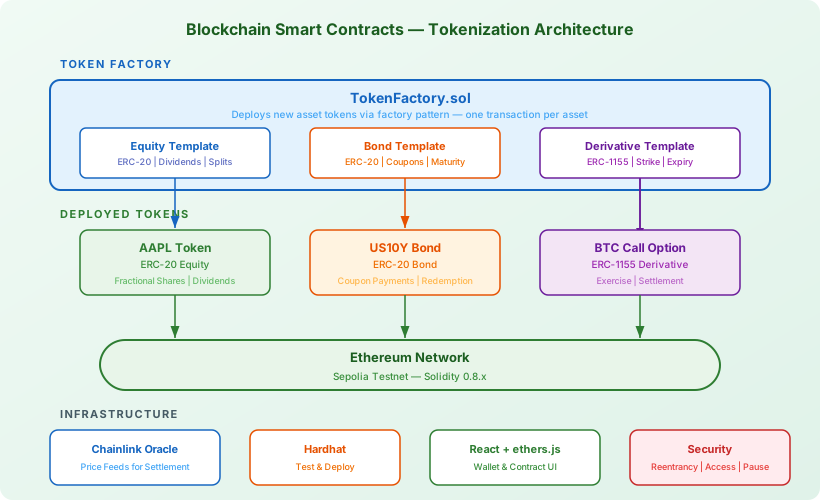
Asset Types & Token Standards
Equities (ERC-20)
Stocks are fungible — one share of AAPL is the same as any other. ERC-20 is the natural fit.
Key features:
- Fractional ownership via token divisibility (18 decimals)
- Dividend distribution through snapshot-based claims
- Corporate actions (splits, mergers) via admin functions
- Transfer restrictions for compliance (whitelisting)
contract EquityToken is ERC20, Ownable {
    string public symbol;         // e.g., "AAPL"
    uint256 public totalShares;

    // Dividend distribution
    mapping(uint256 => uint256) public dividendPerShare;
    uint256 public currentEpoch;

    function claimDividend(uint256 epoch) external { ... }
    function distributeDividend() external onlyOwner { ... }
}
Bonds (ERC-20)
Bonds are fungible within the same issuance. The smart contract encodes coupon payments and maturity.
Key features:
- Automated coupon payments on schedule
- Maturity date with redemption logic
- Yield calculation helpers
- Credit rating metadata
contract BondToken is ERC20, Ownable {
    uint256 public faceValue;
    uint256 public couponRate;      // basis points
    uint256 public maturityDate;
    uint256 public couponFrequency; // seconds between payments

    function payCoupon() external { ... }
    function redeem() external { ... }
}
Futures & Options (ERC-1155)
Derivatives are semi-fungible — contracts with the same strike and expiry are interchangeable, but different strikes are not. ERC-1155 handles this naturally.
Key features:
- Each token ID represents a unique (strike, expiry, type) combination
- Expiry and settlement mechanics
- Oracle integration for price feeds (Chainlink)
- Margin and collateral management
contract DerivativeToken is ERC1155, Ownable {
    struct Contract {
        uint256 strike;
        uint256 expiry;
        bool isCall;       // true = call, false = put
        address underlying;
    }

    mapping(uint256 => Contract) public contracts;

    function exercise(uint256 tokenId) external { ... }
    function settle(uint256 tokenId) external { ... }
}
Smart Contract Factory
The factory pattern allows deploying new asset tokens with a single transaction:
contract TokenFactory is Ownable {
    event TokenCreated(address token, string assetType, string symbol);

    function createEquity(
        string memory name,
        string memory symbol,
        uint256 totalShares
    ) external returns (address) { ... }

    function createBond(
        string memory name,
        uint256 faceValue,
        uint256 couponRate,
        uint256 maturityDate
    ) external returns (address) { ... }

    function createDerivative(
        address underlying,
        uint256[] memory strikes,
        uint256[] memory expiries
    ) external returns (address) { ... }
}
Technology Stack
| Component | Technology | Why |
|---|---|---|
| Smart Contracts | Solidity 0.8.x | Industry standard for Ethereum |
| Framework | Hardhat | Testing, deployment, debugging |
| Testing | Chai, Mocha | Comprehensive unit and integration tests |
| Price Feeds | Chainlink | Decentralized oracle for settlement |
| Frontend | React + ethers.js | Wallet connection and contract interaction |
| Network | Ethereum Sepolia (testnet) | Free testing environment |
Security Considerations
Financial smart contracts require rigorous security:
- Reentrancy protection — all external calls follow checks-effects-interactions
- Access control — role-based permissions (admin, issuer, trader)
- Pausability — emergency stop mechanism for all token contracts
- Upgradeability — proxy pattern for bug fixes without redeployment
- Overflow protection — Solidity 0.8.x built-in checks
- Oracle manipulation — time-weighted average prices, multiple oracle sources
What You’ll Learn
This project demonstrates:
- How to model different financial instruments as smart contracts
- The ERC-20 and ERC-1155 token standards and when to use each
- Factory pattern for smart contract deployment
- Oracle integration for real-world price data
- Security patterns for financial smart contracts
- Testing strategies for Solidity contracts
Repository
The full source code is available on GitHub: diepdaocs/tokenized-assets
Comments